

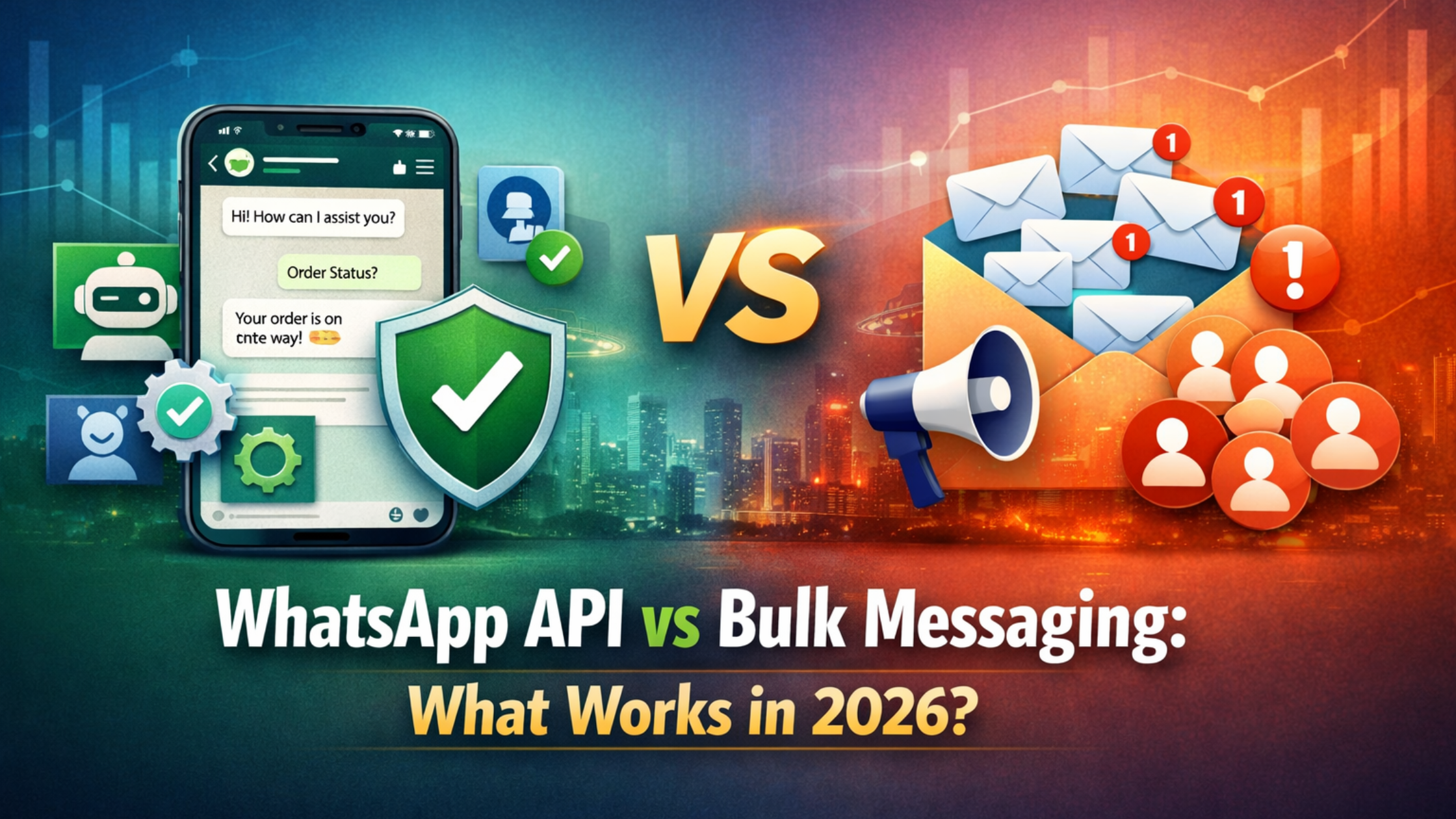
If your business is using WhatsApp to talk to customers, chances are you’ve heard these two terms a lot:
- WhatsApp Business API
- Bulk WhatsApp Messaging
But the big question in 2026 is 👉 which one actually works better?
Which one gives replies, conversions, and long-term growth — and which one gets your number blocked?
First, What Is Bulk WhatsApp Messaging?
Bulk WhatsApp messaging usually means:
- Sending messages to thousands of users at once
- Using unofficial tools or extensions
- No user consent or opt-in
- Same message sent to everyone
It sounds attractive because:
- It’s cheap
- It’s fast
- It promises instant reach
But here’s the reality in 2026 👇
❌ Problems with Bulk WhatsApp Messaging
- High chances of number ban
- Messages marked as spam
- No personalization
- No automation or reply handling
- No analytics or delivery tracking
- Violates WhatsApp policies
Many businesses still use it, but most of them ask the same question later:
“Why did my WhatsApp number get blocked?”
What Is WhatsApp Business API?
The WhatsApp Business API is the official and approved way to send messages on WhatsApp at scale.
It is designed for:
- Businesses
- Startups
- E-commerce
- Customer support
- Marketing & automation
With WhatsApp API, you can:
- Send messages only to opt-in users
- Use approved message templates
- Automate conversations
- Integrate with CRM, websites, and apps
- Track delivery, reads, and replies
In short — it’s built for long-term WhatsApp marketing.
WhatsApp API vs Bulk Messaging: Quick Comparison
| Feature | WhatsApp Business API | Bulk Messaging |
| Official & Legal | ✅ Yes | ❌ No |
| Account Safety | ✅ Very High | ❌ Very Risky |
| Automation | ✅ Yes | ❌ No |
| Personalization | ✅ Yes | ❌ No |
| Two-way Chat | ✅ Yes | ❌ Mostly One-way |
| Analytics & Reports | ✅ Yes | ❌ No |
| Suitable for 2026 | ✅ 100% | ❌ Not Recommended |
What Actually Works Better in 2026?
Let’s be honest.
🚀 WhatsApp API clearly wins in 2026
Why?
Because WhatsApp has become strict.
- Spam detection is smarter
- Users block unwanted messages faster
- Meta actively bans unofficial tools
- Businesses need trust, not shortcutsause WhatsApp has become strict.
Bulk messaging may give short-term reach, but WhatsApp API gives long-term results.
Why Businesses Are Switching to WhatsApp API in 2026
Here’s what we’re seeing across industries
1. Better Open & Reply Rates
WhatsApp messages already have 90%+ open rates, but API messages get real replies, not just views.
2. Automation That Feels Human
With WhatsApp API, you can:
- Auto-reply to leads
- Send order updates
- Share payment links
- Run drip campaigns
3. Zero Fear of Ban
Since it follows WhatsApp policies, your number stays safe.
4. Works Perfectly with Marketing & Sales
You can connect the WhatsApp API with:
- Facebook Click-to-WhatsApp Ads
- CRM tools
- E-commerce platforms
- Lead forms
This is why WhatsApp marketing is exploding in 2026.
Is Bulk WhatsApp Messaging Completely Dead?
Not fully — but it’s dangerous.
Bulk messaging might still work for:
- Very small internal groups
- Temporary campaigns (high risk)
- One-time testing (not recommended)
But for serious businesses, bulk WhatsApp messaging is not future-proof.
Final Thoughts:
In 2026, WhatsApp is no longer just a chat app — it’s a business communication platform.
Businesses that adapt to:
- WhatsApp API
- Automation
- Consent-based messaging
…are winning.
Those still using bulk WhatsApp messaging are slowly disappearing.
If you’re serious about WhatsApp marketing, WhatsApp automation, and business growth, the choice is clear.